
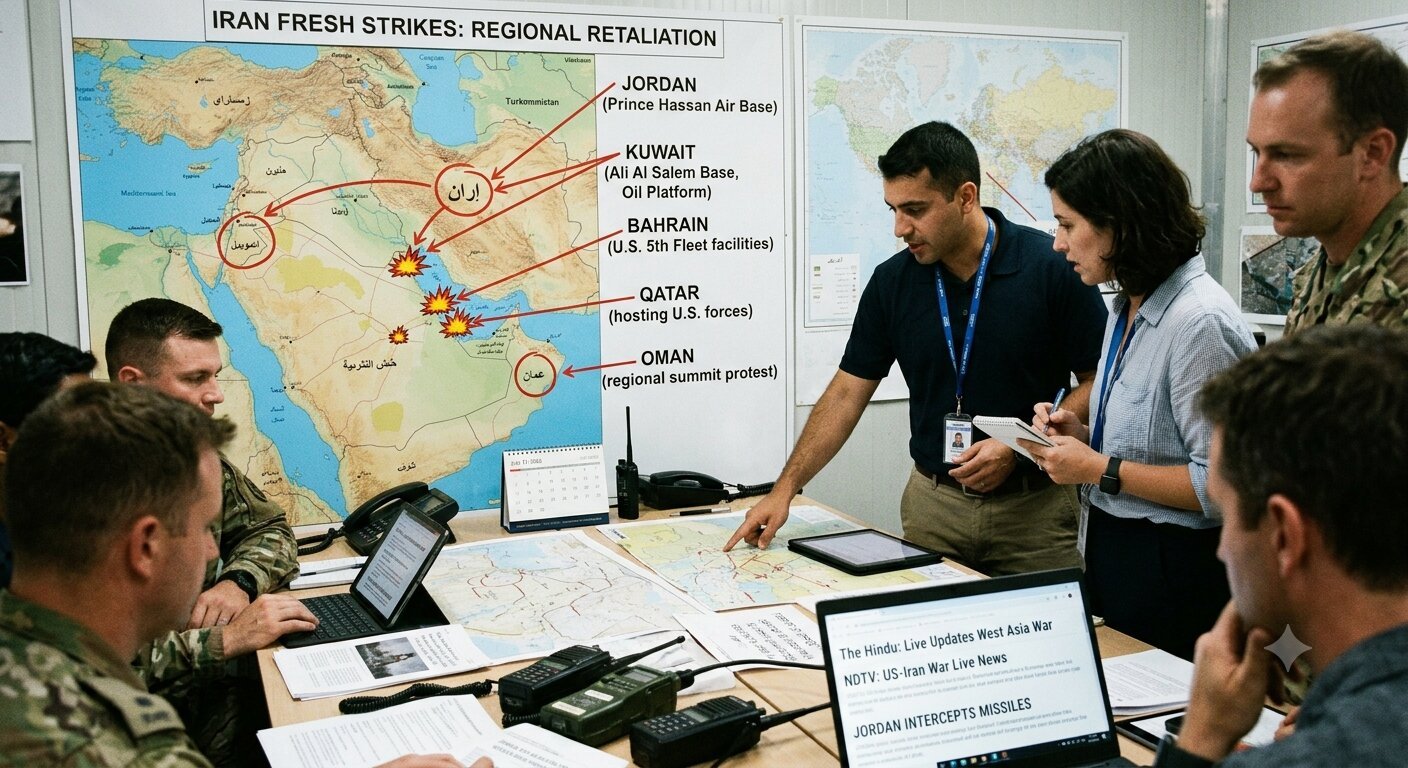
The Regional Ripple Effect: Iran’s Five-Front Retaliation
The conflict in West Asia has entered a dangerous new phase as a cycle of tit-for-tat strikes between the United States and Iran threatens to collapse the fragile interim ceasefire deal reached last month. The current escalation, which began around July 7, intensified significantly over the weekend of July 12–13, 2026, as both nations clash over control of the strategic Strait of Hormuz.
Escalation in the Strait of Hormuz
The latest round of violence was triggered by an Iranian strike on a container ship in the Strait of Hormuz, which set the vessel ablaze and forced its crew to abandon it. The U.S. military responded with a series of heavy airstrikes on Iranian territory, hitting roughly 140 targets—including missile and drone launch sites, ammunition dumps, and communication equipment—on Saturday night alone. U.S. Central Command (CENTCOM) described the operations as necessary to "degrade" Iran's ability to attack commercial shipping and civilian mariners freely transiting the waterway.
Iran, which claims the strait falls within its territorial waters and has periodically declared it closed to traffic, responded by asserting its sovereignty and lashing out at U.S.-aligned nations in the Gulf.
Retaliatory Attacks Across the Region
Following the U.S. airstrikes, Iran’s Islamic Revolutionary Guard Corps (IRGC) launched a series of retaliatory missile and drone attacks targeting nations hosting U.S. military forces. Key developments include:
Jordan: The Jordanian military reported intercepting and shooting down four Iranian missiles that entered its airspace, with reports of strikes hitting the Prince Hassan Air Base.
Kuwait: Kuwaiti armed forces responded to "hostile aerial targets" over their airspace, and Iranian strikes reportedly hit airbases, including Ali Al Salem, and damaged land border posts and an offshore oil platform.
Bahrain: Missile alert sirens were sounded multiple times in Bahrain, home to the U.S. Navy’s 5th Fleet, as Iranian forces targeted U.S. facilities.
Qatar and Oman: Iran also extended its strikes to Qatar and Oman, prompting Omani officials to summon the Iranian ambassador to protest the "irresponsible" acts.
Diplomatic Fallout and Global Reaction
The rapid deterioration of the situation has drawn urgent calls for restraint. U.N. Secretary-General Antonio Guterres has publicly urged both the United States and Iran to halt the fighting and resume negotiations.
The instability has had immediate global economic consequences, with oil prices spiking more than 4% on Monday morning. Meanwhile, the ongoing war remains a volatile backdrop for regional politics; notably, Israel announced it will hold national elections on October 27, a vote expected to serve as a referendum on Prime Minister Benjamin Netanyahu’s leadership throughout the current conflict.
With both Washington and Tehran asserting their right to control the Strait of Hormuz, the interim ceasefire signed on June 17 appears increasingly precarious, leaving the future of diplomatic efforts to end the war in significant doubt.