The End of Reaction: Why AI Resilience Must Be Proactive
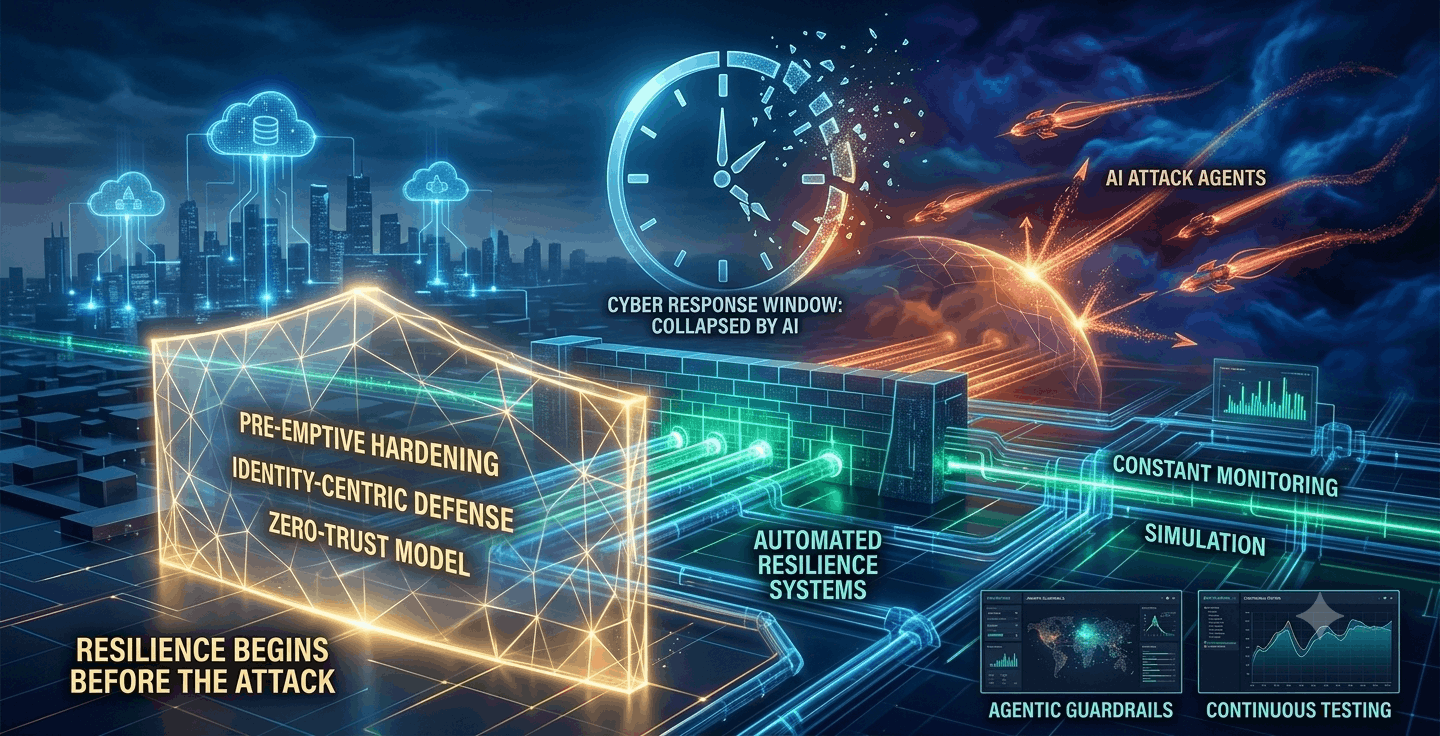
In the era of traditional cybersecurity, companies operated with a manageable "response window"—a period of time between the detection of a threat and the moment an attacker could cause widespread damage. That window has effectively collapsed. Today, AI-powered automation allows cyberattackers to execute complex, multi-stage breaches at machine speed, often moving from initial access to data exfiltration in a matter of seconds.
This rapid acceleration means that incident response, once the gold standard of security, is no longer sufficient on its own. Resilience now begins long before a threat is ever detected. You can read more about how the current threat landscape is forcing this shift
Moving Beyond Incident Response
The primary challenge is that traditional security tools rely on human analysts or rule-based triggers that simply cannot keep pace with AI-driven exploits. Attackers are now using autonomous agents to scan for vulnerabilities, craft sophisticated phishing lures, and rotate credentials faster than any human-led security operations center (SOC) can react.
To combat this, organizations are shifting their focus toward "pre-emptive resilience." This approach emphasizes hardening the environment before a breach occurs, rather than waiting to patch holes after they are exposed. This involves implementing zero-trust architectures, ensuring strict identity management, and using AI of our own to simulate attacks and identify potential weaknesses before malicious actors can find them.
Building Inherent Resilience
Building a pre-emptive defense relies on several key pillars:
Automated Hardening: Using AI to continuously scan and re-configure environments to minimize the "attack surface," closing off unused ports, services, and credentials.
Identity-Centric Security: Since AI agents rely on stolen identities to move laterally, enterprises are moving toward ephemeral, just-in-time access, which renders long-term stolen credentials useless.
Agentic Oversight: As more businesses deploy their own AI agents, they are implementing "guardrail" layers that monitor agent behavior in real-time, preventing them from being tricked into performing malicious actions.
Continuous Simulation: Rather than relying on annual penetration tests, companies are deploying AI-based "red teaming" that constantly tests the network’s defenses against the latest automated threat patterns.
The New Security Standard
The reality is that attackers will always have the advantage of spontaneity, but defenders can have the advantage of control. By shifting the focus from the chaotic aftermath of a breach to the proactive design of the infrastructure itself, companies can effectively neutralize the speed advantage that AI has handed to attackers. Resilience today is measured by the ability of a system to maintain integrity even when under active, automated assault. As we look toward the future, the companies that succeed will be those that realize the best defense against an AI attack is a system that was never vulnerable in the first place.