
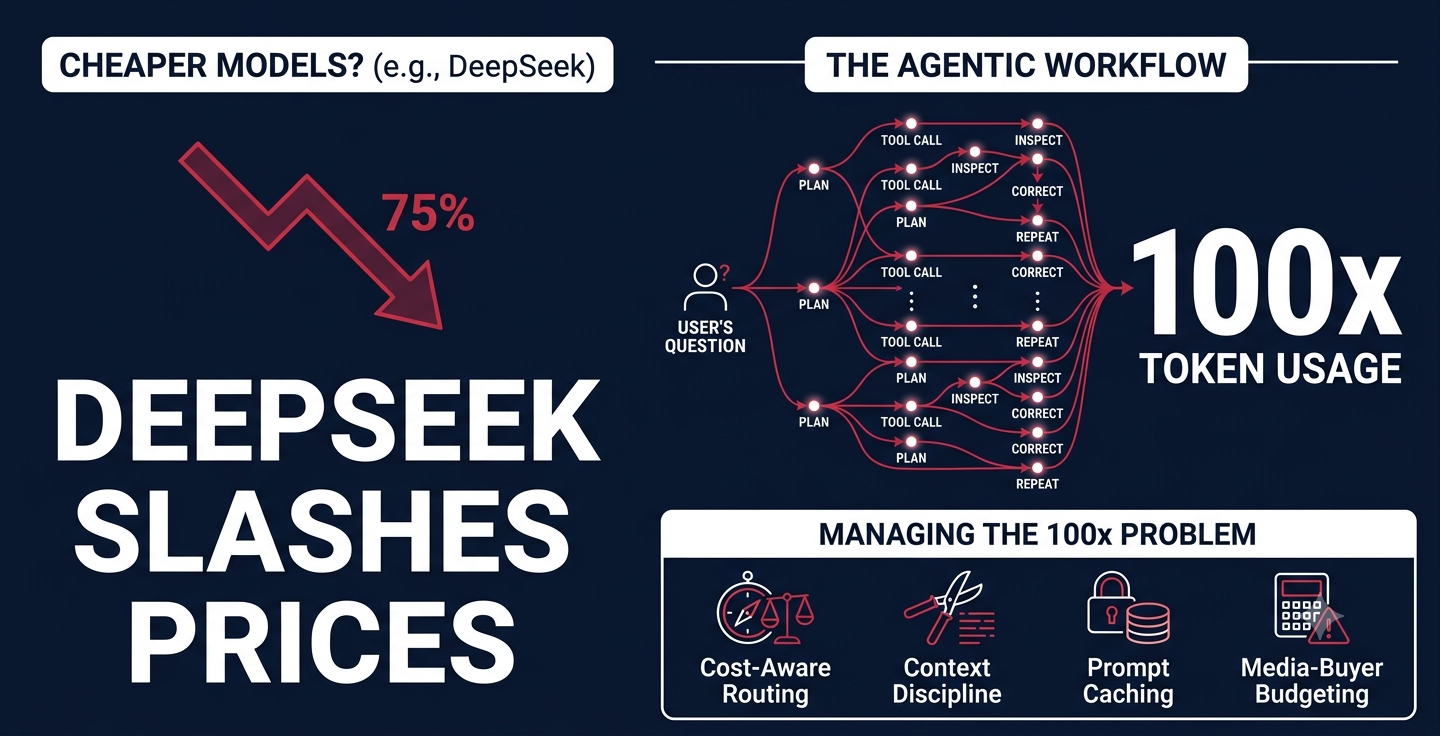
The 75% Cut Paradox: Why DeepSeek’s Pricing Won’t Solve the Agentic Cost Crisis
DeepSeek’s recent move to permanently slash prices on its flagship V4-Pro model by 75% marks a significant escalation in the ongoing AI pricing war, positioning the company as a low-cost leader in the premium language model market. By optimizing its software to leverage local hardware, specifically Huawei Ascend 950 semiconductors, DeepSeek has managed to undercut both domestic and Western competitors, making advanced AI integration more accessible than ever. However, while this drastic reduction in per-token costs should logically benefit enterprise AI vendors, many are discovering that lower prices do not automatically lead to healthier margins.
To manage the "100x problem" and keep costs sustainable, focus on these four strategies:
Cost-Aware Routing: Use a small, efficient model to classify tasks and only trigger expensive high-tier models when necessary.
Context Discipline: Actively prune reasoning traces and truncate tool outputs to prevent agents from consuming unnecessary tokens.
Prompt Caching: Leverage vendor-provided caching to avoid paying for static system prompts or repetitive knowledge base data with every request.
Budgeting as Strategy: Treat inference costs like a media-buying budget by setting strict ceilings and implementing automated alerts for feature-level overruns.
The core of the issue lies in what industry observers call the "100x problem". While inference costs are falling, the shift from simple, reactive chatbots to complex, autonomous AI agent workflows is causing token consumption to skyrocket. Unlike a standard chatbot that translates one user question into a single model call, an agentic workflow involves iterative planning, tool execution, and self-correction, often consuming significantly more tokens to complete a single user-visible task. In these long-running, multi-step processes, the agent can consume hundreds of times more tokens than traditional methods, effectively negating the savings generated by cheaper models.
This creates a precarious economic paradox for software vendors. Often, the customers who derive the most value from these sophisticated agentic products are the same ones generating the highest inference costs. As usage scales, these infrastructure expenses can transition from negligible operating costs to material burdens that erode vendor gross margins, sometimes even turning them negative.
To survive this era of AI infrastructure pricing, organizations must move beyond simply relying on the cheapest models. Success will likely belong to companies that treat inference costs as a first-class financial metric, implementing techniques like cost-aware routing—which uses small classifiers to direct queries to the appropriate model tier—and strict context discipline to prune unnecessary tool outputs or reasoning traces. Ultimately, the architecture of an agent has become a financial decision in real-time, where an unoptimized loop is no longer just a technical oversight, but a significant margin event.